Traceability
Logging and traceability of surveys
Who analyzed this photo, with which engine, and who approved the write to the inventory? Each survey and each decision leaves a trace you can find again.
Contents
Why trace an inventory
An inventory is only valuable if you know where it comes from. When a line changes in the inventory, three questions always come up: on what basis, decided by whom, and when. Without answers, the reference inventory loses the trust of the teams and people end up going back to check on site.
The platform answers these questions at two levels: the survey itself, which keeps everything used to produce it, and the action log, which keeps a trace of the decisions.
What each survey keeps
A survey is not just a result. It keeps the elements that make it possible to review it later:
- The photo analyzed, as it was received.
- The date and author of the survey.
- The analysis engine used and its version: a result obtained with a given version remains identifiable after an update.
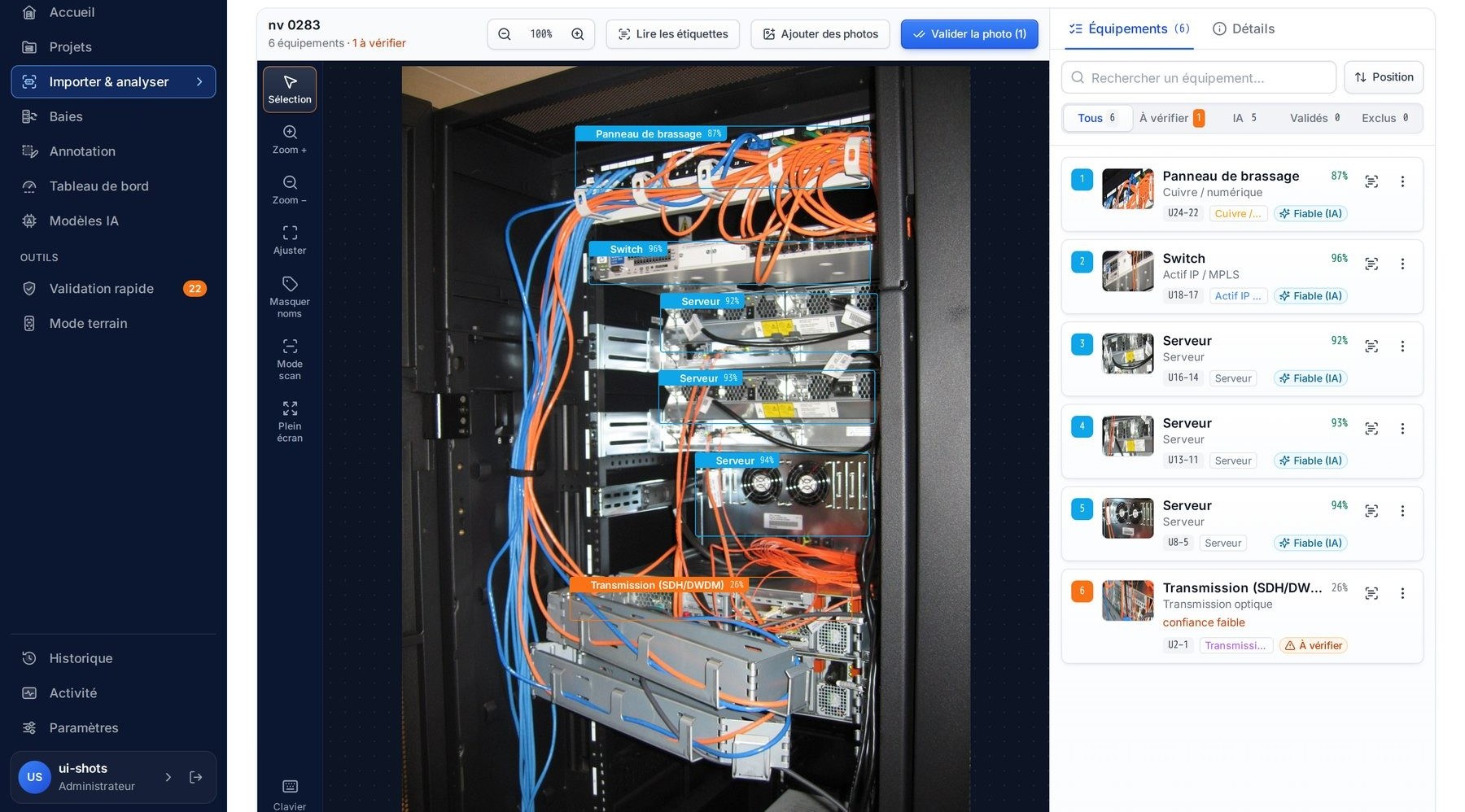
- The detections: bounding box, family, U position and confidence level of each piece of equipment.
- The comparison with the inventory: matching, different from the inventory, not in the same position, missing from the inventory, in the inventory, not seen, out of view.
- The decisions taken on each discrepancy, and their history.
What the action log records
The action log records the operations that matter: analyses, approvals, writes to the inventory. For each one, it keeps who performed it, when, and on which rack.
For example, it makes it possible to answer these questions:
- Who approved the change to this equipment in the inventory, and based on which survey?
- Which racks at a site were surveyed during the last campaign?
- With two-level approval, who proposed, and who approved?
Logins are also controlled: login attempts are limited and sessions have a limited duration.
A chain of evidence, from photo to inventory
Put end to end, the survey and the log form a continuous chain:
The photo
Taken in the field, attached to a rack and a date.
The analysis
The engine, identified by its version, proposes the equipment and their positions.
The comparison
The platform recognizes the rack and compares the photo to the inventory, U by U.
The decision
A person handles each discrepancy, possibly approved by a second person.
The write
The inventory is updated via the connector, and the operation is recorded in the log.
At each link, the trace shows who was involved. This is what makes it possible to trust the reference inventory without rechecking everything.
When the engine changes version
The analysis engine evolves: a new version may recognize certain equipment better or place a U position more precisely. These changes must not blur the past. Because each survey keeps the engine and the version that produced it, an old result remains readable for what it is: the output of a given version, on a given date, approved or corrected by an identified person.
If you want to review a rack with the new version, simply run the comparison again or start a new survey. The old survey is not rewritten: both coexist, and the rack history shows the sequence of visits.
Using the traces
The traces are useful day to day as well as in audits. Surveys and the survey plan can be exported to CSV; the site report can be exported to PowerPoint for a review or a committee. Log retention, any centralization in your tools and review frequency are a matter for your security policy; the technical arrangements are to be specified within the project.
To learn more about the contents of the log, contact us.