GDPR
GDPR and personal data in rack photos
A rack photo targets equipment, not people. Yet it can capture a face, a badge or a name label. Here is how to limit this risk and what remains your responsibility.
Contents
What the platform actually processes
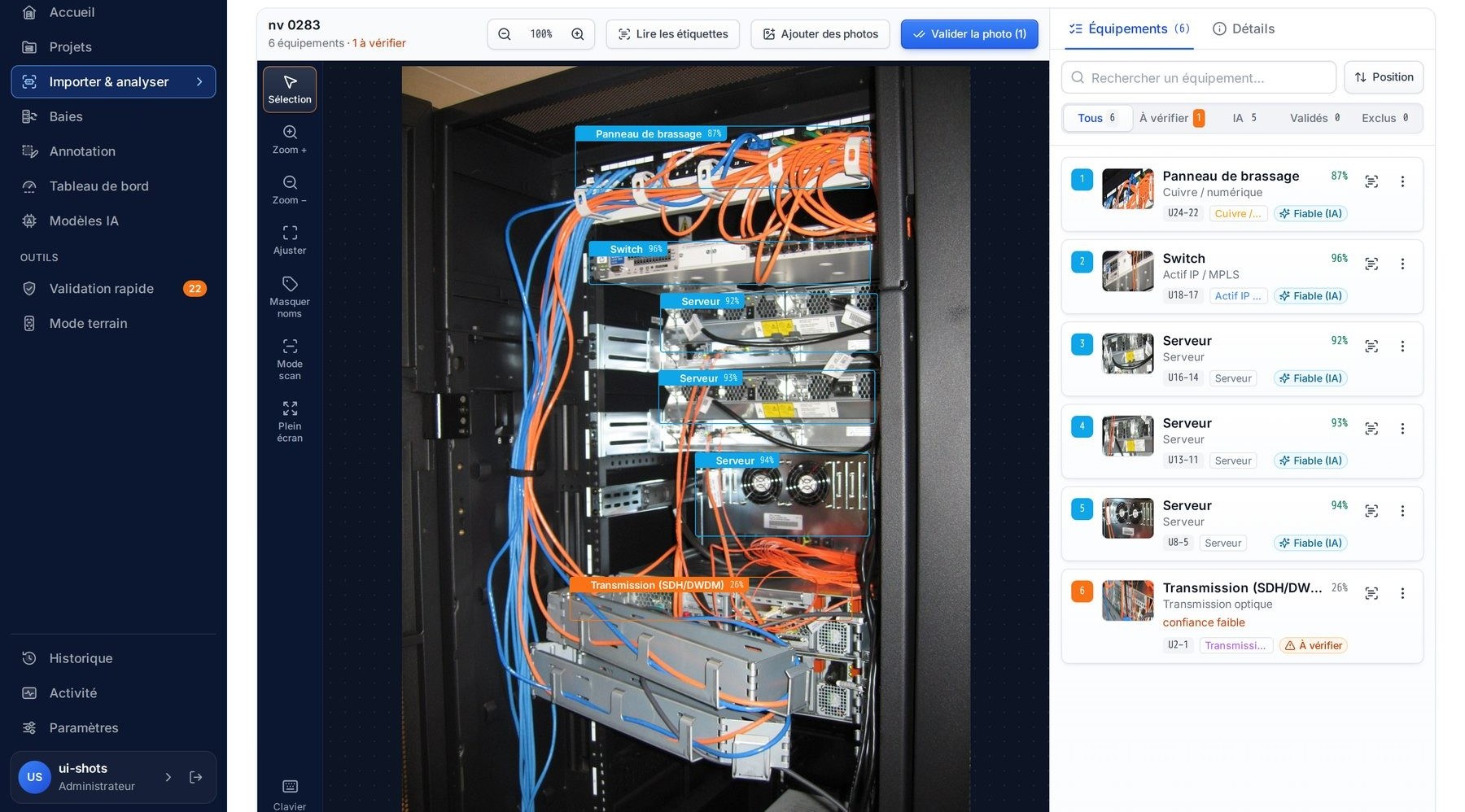
The platform needs two things to produce a survey: a front photo of the entire rack and, if you use one, the inventory of that rack in your inventory tool. The analysis looks for equipment on the front face, its family, its U position and a confidence level. It does not look for faces, names or information about a person.
The only personal data needed for operation is that of user accounts: a name, a username and a role. It is used to open a session and to record who did what in the action log.
A photo is still a photo, however. Taken in a room, it can contain elements that no one meant to capture. This is the point that needs careful handling.
What a photo can capture unintentionally
In the field, the most frequent situations are easy to anticipate:
- A face or a silhouette: a colleague in the aisle, a reflection on a glass door or on the front of a device.
- A badge worn or left on a device, with a name and sometimes an ID photo.
- A name label: name of a person in charge, direct phone number, email address stuck on a chassis or a door.
- A document left on top of a rack: work order, schedule, visit sheet.
These elements add nothing to the inventory. Avoiding them when the photo is taken is the most effective measure, because data that was never collected does not have to be protected or deleted.
Minimize from the moment the photo is taken
The GDPR data minimization principle (Article 5) requires collecting only what is necessary. For a rack survey, this translates into a few instructions to give field teams:
Frame the rack, and only the rack
A front photo, the entire rack in the frame, the uprights visible. No need to widen to the aisle or the neighboring racks.
Check the aisle before taking the shot
Wait until no one is passing through the frame and avoid angles that produce reflections.
Remove what does not belong there
Badge, document, notebook left on a device: move them while the photo is taken.
Retake rather than keep
If a photo still captures a person or personal name information, retake it, preferably before sending; a photo already sent is reported to an administrator, who has it removed.
These instructions can be included in the visit sheet given to technicians when a campaign is launched.
Who is the controller
The platform is installed on your servers, in containers. Photos, surveys and accounts are stored on your infrastructure. You decide how they are used: you are therefore, as a general rule, the controller within the meaning of the GDPR.
In practice, this means that several items fall to you:
- The legal basis for the processing (Article 6): for the inventory of your own estate, legitimate interest or the performance of an internal task are often considered. The choice is up to your DPO.
- The entry in the record of processing activities (Article 30), with the categories of data (user accounts, room photos) and their retention periods.
- Informing the data subjects: the users of the platform and, where applicable, the staff present in the rooms.
- The data protection impact assessment (Article 35), if your DPO considers it necessary. An equipment inventory does not target people, but the assessment is up to you.
If support from us involves access to your data, this is set out in the contract, under Article 28. It is to be specified within the project.
What the platform provides to help you
Several design choices support data protection:
- Photos stay on your servers: no online service is required to analyze a photo.
- Accounts are created by an administrator, with separate roles: each user sees only what their role allows.
- The action log records who analyzed, approved or wrote what, and when: useful to respond to a request or an inspection.
- Accounts contain only what is strictly necessary: name, username, role.
For any question, or to receive the description of the processing within a project, write to us.
This page describes the product and how it is designed. It does not constitute legal advice: confirm how it applies to your context with your DPO, your CISO or your counsel.